MathematicsGrade 4

Angle Gate

If the arms get longer, does the angle get bigger?

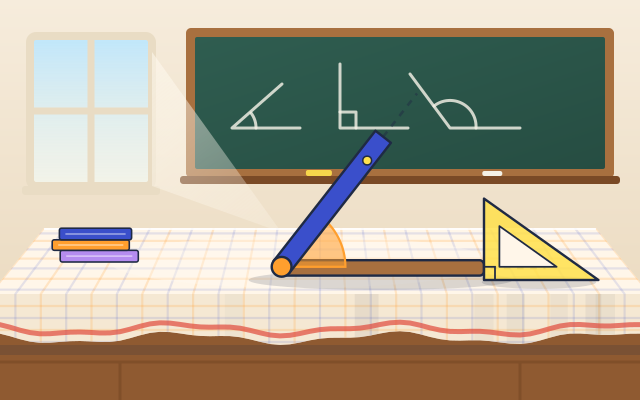
Open the toy door and stretch its arms. Does the angle change? Find acute, right and obtuse angles with a set square.

The big question

What makes an angle bigger: the length of its arms or how far it turns?

≈ 20 min exploring40-min lessonTurkish · EnglishNo scores

Choose a grade and start

The lab opens in the version for the grade you choose; grade and language can also be changed inside the lab.

I made the arms longer. Do you think the angle got bigger?

How it works

What children do

Here is how the eight steps of the explorer cycle unfold in this lab.

  1. 1

    Ready?

    Meets the hinged door, the robot arm and the set square.

  2. 2

    What do I know?

    Shows which is bigger: a wide angle with short arms or a narrow angle with long arms.

  3. 3

    In everyday life

    Thinks about door hinges, scissors, clock hands and elbows.

  4. 4

    Predict

    Predicts whether the angle grows when the arms get longer; the prediction is locked in.

  5. 5

    Try and observe

    The arms grow but the angle reading stays the same; the flashlight beam just reaches further.

  6. 6

    Why?

    Sees that an angle is an amount of turn; uses the right angle as a reference and learns ray, vertex and the angle symbol.

  7. 7

    Try something new

    Measures with a protractor, draws an angle of a given size and sorts acute, right and obtuse angles with a set square.

  8. 8

    My explorer notebook

    Picks the door that has turned the most out of three with different arm lengths.

Mathematics

Grades and learning outcomes

Codes and outcomes come from the Turkish national curriculum taught in 2026–27, word for word in Turkish; the English here is our translation of that text, not an official version. Grade 4 follows the 2018 curriculum; its Maarif Model equivalent is shown separately.

Grade 4

Start

Rays, vertex and symbol; measuring with non-standard units and a protractor; acute, right, obtuse and straight angles (2018 curriculum).

  • M.4.2.3.22018 curriculum· translated from Turkish

    Identifies the rays and the vertex that form an angle, names the angle and shows it with a symbol.

  • M.4.2.3.32018 curriculum· translated from Turkish

    Measures angles with non-standard units and explains why standard units of measurement are needed.

  • M.4.2.3.42018 curriculum· translated from Turkish

    Measures angles with standard angle-measuring tools and identifies them as acute, right, obtuse or straight angles.

    • a) Comparisons use the right angle as the reference.
    • b) When obtuse angle models are examined, care is taken that they are not larger than a straight angle.
  • M.4.2.3.52018 curriculum· translated from Turkish

    Constructs an angle of a given measure using standard angle-measuring tools.

    • a) Using angle-measuring tools (protractor, set square, etc.), pupils notice that an angle is formed by turning a ray around its starting point.
    • b) It is stressed that angles with the same measure keep that measure whatever their orientation.

Equivalent from 2027–28

  • MAT.4.3.5Maarif Model 2026· translated from Turkish

    Interpreting an angle as an amount of turn through everyday examples

    • a) Identifies angles through everyday examples.
    • b) Turns angles into everyday situations without losing their context.
    • c) Restates an angle as an amount of turn.
  • MAT.4.3.6Maarif Model 2026· translated from Turkish

    Evaluating the need for standard tools to measure angles

    • a) Sets a criterion for measuring angles.
    • b) Measures with non-standard units in line with the criterion.
    • c) Compares the results obtained with non-standard units against the criterion.
    • ç) Judges, from these comparisons, whether standard measuring tools are needed.
  • MAT.4.3.7Maarif Model 2026· translated from Turkish

    Classifying angles as acute or obtuse using the right angle as a reference

    • a) Identifies the properties of a right angle.
    • b) Separates angles into acute and obtuse angles using the right angle as a reference.
    • c) Sorts the properties of acute and obtuse angles.
    • ç) Names acute and obtuse angles.

Curriculum mapping

This lab is mapped to learning outcomes M.4.2.3.2, M.4.2.3.3, M.4.2.3.4 and M.4.2.3.5 of the Turkish Ministry of National Education's 2018 Mathematics curriculum. It has not been reviewed or approved by the Ministry of National Education (MEB) or its Board of Education (TTKB).

From the 2027–28 school year, the grade 4 equivalent in the Türkiye Century Maarif Model is MAT.4.3.5, MAT.4.3.6 and MAT.4.3.7.

For teachers

Teacher notes

Open the teacher card

Goal

Children compare angles by how far they turn rather than by arm length, and identify acute, right, obtuse and straight angles against a right angle.

Getting ready

  • Open the lab on the board; grade 4 is selected.
  • For the screen-free activity: two long and two short pencils or rulers and a set square.
  • Angle numbers are large on the board; check they can be read from the back row.

Class prediction vote

If we make the door's arms longer, does the angle get bigger?

  • It gets bigger
  • It gets smaller
  • It stays the same

Children show their choice with their fingers and you count. Then you watch the result together.

Discussion questions

  1. The arms got longer, so why did the angle stay the same?
  2. What if we opened the door a bit more?
  3. How can we tell an angle is bigger than a right angle?

Avoid saying

“The angle with longer arms is bigger.”

Say instead

“An angle is about how far it turns; longer arms don't change it.”

Off-screen activity for the teacher's desk: Turning arms

Pupils start with their arms together, then open them as far as you say: less than a right angle, a right angle, more than a right angle. Then hold two pencils on the teacher's desk at the same angle and swap them for longer ones.

You need

  • Two long and two short pencils or rulers
  • A set square

Misconceptions

What children may think“The angle with longer arms is bigger.”
What the lab showsThe arms grow but the angle reading doesn't change; the arms just reach further.
What children may thinkThinking only right angles are angles.
What the lab showsThe door makes an angle in every position; acute and obtuse angles are compared with a right angle using the set square.

Scope

The Maarif Model version (from 2027–28) has no protractor measuring and no straight angle; in 2026–27 this lab follows the 2018 curriculum.

Preparing the experience…