ScienceGrade 4

State Kitchen

Where did the water go?

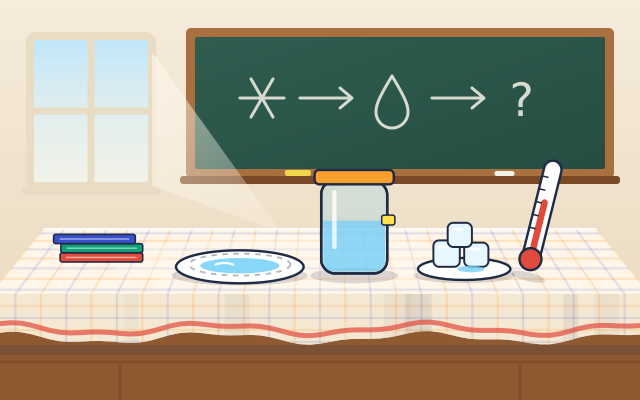
Melt the ice, freeze the water, watch the water on the plate go down. Why does the water in the jar stay put?

The big question

When water warms up or cools down, where does it go? Does it disappear?

≈ 20 min exploring40-min lessonTurkish · EnglishNo scores

Choose a grade and start

The lab opens in the version for the grade you choose; grade and language can also be changed inside the lab.

The water on the plate went down. Where do you think it went?

How it works

What children do

Here is how the eight steps of the explorer cycle unfold in this lab.

  1. 1

    Ready?

    Meets the ice tray, the pot, the safe toy stove, the open plate, the lidded jar and the thermometer.

  2. 2

    What do I know?

    Shows an answer to “Where does the water go when wet laundry dries?”: does it vanish or mix into the air?

  3. 3

    In everyday life

    Thinks about ice in the freezer, drying laundry and the mist from the teapot.

  4. 4

    Predict

    Predicts what will happen to the water on the open plate and in the closed jar; the prediction is locked in.

  5. 5

    Try and observe

    In sped-up time, the water line on the plate drops while the one in the jar stays put.

  6. 6

    Why?

    Learns the names melting, freezing and evaporation: the water didn't vanish, it became invisible.

  7. 7

    Try something new

    Tries the same water at different temperatures; melts ice and freezes water with the heat–cool slider.

  8. 8

    My explorer notebook

    Picks which of three short animations shows evaporation.

Science

Grades and learning outcomes

Codes and outcomes come from the Turkish national curriculum taught in 2026–27, word for word in Turkish; the English here is our translation of that text, not an official version. Grade 4 follows the 2018 curriculum; its Maarif Model equivalent is shown separately.

Grade 4

Start

Heat–cool slider, open plate and closed jar; melting, freezing and evaporation only. No particle model and no condensation (2018 curriculum).

  • F.4.4.3.12018 curriculum· translated from Turkish

    Compares the basic properties of the states of matter.

    • The particle model and the space between particles are not covered.
  • F.4.4.3.22018 curriculum· translated from Turkish

    Gives examples of different states of the same substance.

  • F.4.4.4.12018 curriculum· translated from Turkish

    Designs experiments on how substances warm up and cool down.

  • F.4.4.4.22018 curriculum· translated from Turkish

    Designs an experiment showing that substances can change state through heat.

    • Of the changes of state, only melting, freezing and evaporation are covered.

Equivalent from 2027–28

  • FB.4.4.1Maarif Model 2026· translated from Turkish

    Making scientific inferences about the changes of state of substances

    • a) Describes the properties of the states of matter.
    • b) Records data on the changes of state of substances.
    • c) Interprets and evaluates data on the changes of state of substances.
  • FB.4.4.2Maarif Model 2026· translated from Turkish

    Carrying out experiments on how heat changes substances

    • a) Designs an experiment on how heat changes substances.
    • b) Measures and analyzes data on how heat changes substances.
Curriculum mapping

This lab is mapped to learning outcomes F.4.4.3.1, F.4.4.3.2, F.4.4.4.1 and F.4.4.4.2 of the Turkish Ministry of National Education's 2018 Science curriculum. It has not been reviewed or approved by the Ministry of National Education (MEB) or its Board of Education (TTKB).

From the 2027–28 school year, the grade 4 equivalent in the Türkiye Century Maarif Model is FB.4.4.1 and FB.4.4.2.

For teachers

Teacher notes

Open the teacher card

Goal

Children name melting, freezing and evaporation from what they observe, and use evidence to explain that evaporated water has not vanished but mixed into the air.

Getting ready

  • Open the lab on the board; grade 4 is selected.
  • For the screen-free activity: two identical clear containers (one with a lid), water, clear tape and a pen.
  • The stove is only a symbol; in a real experiment, only the teacher handles hot surfaces.

Class prediction vote

What will happen to the water on the open plate and in the closed jar after a week?

  • Both go down
  • Only the plate goes down
  • Both stay the same

Children show their choice with their fingers and you count. Then you watch the result together.

Discussion questions

  1. Why didn't the water in the jar go down?
  2. What if we put the plate in the sun?
  3. How do we know the water didn't vanish?

Avoid saying

“When water evaporates, it disappears.”

Say instead

“When water evaporates, it mixes into the air. We can't see it, but it hasn't disappeared.”

Off-screen activity for the teacher's desk: Plate and jar

Pour the same amount of water into two identical containers and close one. Mark the water levels with tape and leave both on the teacher's desk. Check the marks together the next day.

You need

  • Two identical clear containers (one with a lid)
  • Water
  • Clear tape and a pen

Misconceptions

What children may think“Evaporated water disappears.”
What the lab showsThe water line in the closed jar stays put while the one on the open plate drops: the water has mixed into the air.

Scope

No particle model, no mass or volume of gases and no condensation (2018 curriculum); changes are shown with drops, mist and the thermometer.

Preparing the experience…