MathematicsGrades 2–4

Fraction Workshop

If you cut it into more pieces, do the pieces get bigger?

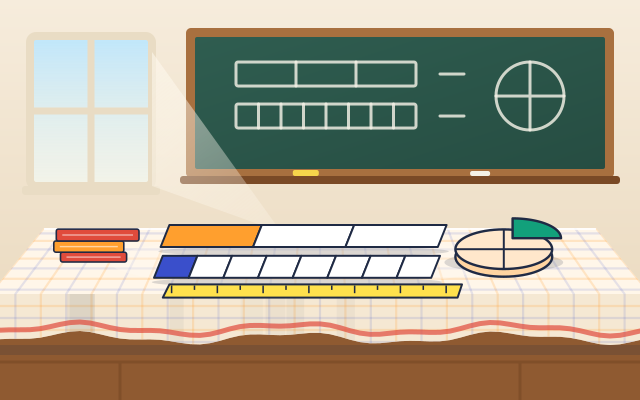
Split same-size strips into equal parts and stack the pieces. Which is bigger: a third or an eighth?

The big question

If you split a whole into more equal parts, does each part get bigger or smaller?

≈ 15 min exploring40-min lessonTurkish · EnglishNo scores

Choose a grade and start

The lab opens in the version for the grade you choose; grade and language can also be changed inside the lab.

Eight pieces or three pieces? Whose piece is bigger? Let's try!

How it works

What children do

Here is how the eight steps of the explorer cycle unfold in this lab.

  1. 1

    Ready?

    Meets the paper strips, the cake model, the cutting ruler and the number line.

  2. 2

    What do I know?

    Shows what they think about “How do two siblings share one apple? Is it fair?”

  3. 3

    In everyday life

    Thinks about flatbread, a chocolate bar and half a loaf of bread.

  4. 4

    Predict

    Predicts at their grade: 2 or 4 equal parts (grade 2), is an unequal piece a quarter (grade 3), is 1/3 or 1/8 bigger (grade 4)?

  5. 5

    Try and observe

    The strips are split and the pieces stacked; the piece they expected to be bigger turns out smaller.

  6. 6

    Why?

    Sees “more equal parts, smaller parts” with strips and, in grades 3–4, with symbols.

  7. 7

    Try something new

    Hunts for equal parts, changes the numerator and denominator, or places fractions on the number line.

  8. 8

    My explorer notebook

    Picks which of three models shows “a quarter”; the one with four unequal pieces is the trap.

Mathematics

Grades and learning outcomes

Codes and outcomes come from the Turkish national curriculum taught in 2026–27, word for word in Turkish; the English here is our translation of that text, not an official version. Grade 4 follows the 2018 curriculum; its Maarif Model equivalent is shown separately.

Grade 2

Start

A whole, a half and a quarter; splitting into 2 or 4 equal parts only. No fraction symbols.

  • MAT.2.1.7Maarif Model 2026· translated from Turkish

    Analyzing the relationship between a whole, a half and a quarter

    • a) Identifies the half and quarter parts of a whole.
    • b) Identifies the relationships between a whole, a half and a quarter.
Grade 3

Start

Equal parts and unit fractions; numerator and denominator, symbols and the number line.

  • MAT.3.1.9Maarif Model 2026· translated from Turkish

    Using models to show a whole, a half and a quarter as fractions

    • a) Recognizes representations of whole, half and quarter models.
    • b) Identifies the fraction representations that match whole, half and quarter models.
    • c) Uses the chosen representation for whole, half and quarter models.
  • MAT.3.1.10Maarif Model 2026· translated from Turkish

    Analyzing a whole as unit fractions by splitting it into equal parts

    • a) Identifies the equal parts that make up a whole.
    • b) Identifies the relationship between the whole and each of the equal parts.
  • MAT.3.1.11Maarif Model 2026· translated from Turkish

    Analyzing the relationship between the numerator and the denominator of a fraction

    • a) Identifies the parts that belong to the numerator and the denominator of a fraction.
    • b) Identifies the relationship between the parts that belong to the numerator and the denominator.

Grade 4

Start

Comparing unit fractions (1/3 and 1/8); proper, improper and mixed fractions; denominators up to 20 (2018 curriculum).

  • M.4.1.6.12018 curriculum· translated from Turkish

    Recognizes proper fractions, improper fractions and mixed numbers, and shows them with models.

    • a) It is stressed that the way a fraction is read can change with its different meanings.
    • b) Naming activities use models (number line, area model, etc.).
  • M.4.1.6.22018 curriculum· translated from Turkish

    Compares and orders unit fractions.

    • a) Work uses fractions with denominators of at most 20.
    • b) The sizes that unit fractions represent are examined on suitable models.
  • M.4.1.6.42018 curriculum· translated from Turkish

    Compares up to three fractions with equal denominators.

    • a) Comparisons use models such as length, area and the number line.
    • b) The greater-than and less-than symbols are used when comparing.
    • c) A given fraction is also compared with zero, one half and one whole on the number line.
  • M.4.1.7.12018 curriculum· translated from Turkish

    Adds and subtracts fractions with equal denominators.

Equivalent from 2027–28

  • MAT.4.1.6Maarif Model 2026· translated from Turkish

    Using mathematical representations to work with proper fractions, improper fractions and mixed numbers

    • a) Recognizes representations of proper fractions, improper fractions and mixed numbers.
    • b) Identifies representations of proper fractions, improper fractions and mixed numbers that fit an everyday situation.
    • c) Uses the representations of proper fractions, improper fractions and mixed numbers they chose.
  • MAT.4.1.7Maarif Model 2026· translated from Turkish

    Using mathematical representations to work with equivalent fractions

    • a) Recognizes representations of equivalent fractions.
    • b) Identifies representations that fit equivalent fractions.
    • c) Uses the representations of equivalent fractions they chose.
  • MAT.4.1.8Maarif Model 2026· translated from Turkish

    Analyzing which unit fractions are greater or smaller

    • a) Describes unit fractions in terms of greater and smaller.
    • b) Identifies which of two unit fractions is greater or smaller.
  • MAT.4.1.9Maarif Model 2026· translated from Turkish

    Analyzing which fractions with equal denominators are greater or smaller

    • a) Describes fractions with equal denominators in terms of greater and smaller.
    • b) Identifies which of the fractions with equal denominators is greater or smaller.
  • MAT.4.1.11Maarif Model 2026· translated from Turkish

    Constructing addition and subtraction with fractions that have equal denominators

    • a) Sets out the logical relationships in adding and subtracting fractions with equal denominators.
    • b) Builds a whole, in their own understanding, from the relationships they found in adding and subtracting fractions with equal denominators.

Curriculum mapping

This lab is mapped to learning outcomes M.4.1.6.1, M.4.1.6.2, M.4.1.6.4 and M.4.1.7.1 of the Turkish Ministry of National Education's 2018 Mathematics curriculum. It has not been reviewed or approved by the Ministry of National Education (MEB) or its Board of Education (TTKB).

This lab is mapped to learning outcomes MAT.2.1.7, MAT.3.1.9, MAT.3.1.10 and MAT.3.1.11 of the Turkish Ministry of National Education's Türkiye Century Maarif Model Mathematics curriculum (2026 version). It has not been reviewed or approved by the Ministry of National Education (MEB) or its Board of Education (TTKB).

From the 2027–28 school year, the grade 4 equivalent in the Türkiye Century Maarif Model is MAT.4.1.6, MAT.4.1.7, MAT.4.1.8, MAT.4.1.9 and MAT.4.1.11.

For teachers

Teacher notes

Open the teacher card

Goal

Children split a whole into equal parts and use a model to show that the more equal parts there are, the smaller each part is.

Getting ready

  • Open the lab on the board and pick the grade.
  • For the screen-free activity: two or three paper strips of the same length per pupil.
  • In grade 2, don't write symbols like ½ on the board; say “half” and “quarter”.

Class prediction vote

If we split one strip into 3 equal parts and another into 8, which part is bigger?

  • One of the 3 parts
  • One of the 8 parts
  • They're the same

Children show their choice with their fingers and you count. Then you watch the result together.

Discussion questions

  1. Why did the parts get smaller when there were more of them?
  2. What if we split the strip into 100 equal parts?
  3. How can we tell the parts are equal?

Avoid saying

“8 is bigger than 3, so an eighth is bigger too.”

Say instead

“The whole stays the same: the more equal parts we cut, the smaller each part.”

Off-screen activity for the teacher's desk: Folding strips

Fold same-length paper strips into 2, 4 and 8 and cut along the folds. Stack the pieces on the teacher's desk to compare them, and show one unequal cut too.

You need

  • Paper strips of the same length
  • Scissors
  • Colored pencils

Misconceptions

What children may think“A unit fraction with a bigger denominator is bigger (1/8 > 1/3).” (grade 4)
What the lab showsTwo equal strips are split into 3 and 8 equal parts; stacked, 1/3 sticks out past 1/8.
What children may thinkCalling unequal pieces “a half”, “a quarter” or “one fourth”.
What the lab showsStacked, the pieces are clearly not equal; only equal parts get these names.

Scope

Grade 2 uses no fraction symbols and grade 3 does not compare fractions. No realistic food textures while the idea is being built.

Preparing the experience…