MathematicsGrades 1–4

Solids Workshop

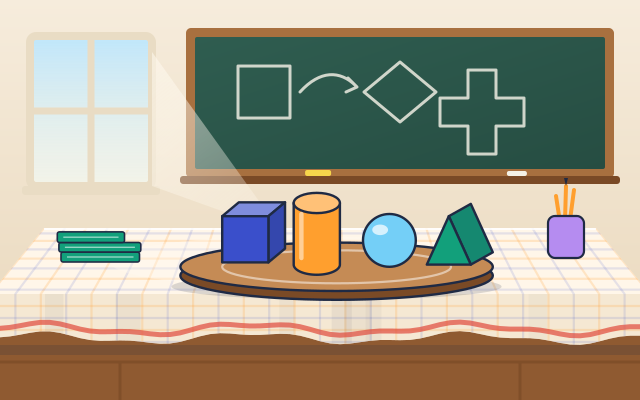
If you turn a square, is it still a square?

Turn and resize toy solids, count their faces or fold the net of a cube. What changes, and what stays the same?

The big question

If we turn a solid, make it bigger or unfold it flat, what stays the same?

≈ 15 min exploring40-min lessonTurkish · EnglishNo scores

Choose a grade and start

The lab opens in the version for the grade you choose; grade and language can also be changed inside the lab.

I turned this square. Is it still a square? What do you think?

How it works

What children do

Here is how the eight steps of the explorer cycle unfold in this lab.

  1. 1

    Ready?

    Meets the turntable and the toy solids.

  2. 2

    What do I know?

    Answers one question for their grade: which one rolls, how many faces does a cube have, will this pattern make a cube?

  3. 3

    In everyday life

    Thinks about a milk carton, a ball, a tin can, a tent and a cardboard box opened flat.

  4. 4

    Predict

    Predicts whether a turned square is still a square, or whether a pattern will fold into a cube.

  5. 5

    Try and observe

    The square turns or the pattern folds, and the result shows.

  6. 6

    Why?

    Sees property cards in their grade's words: round or with corners; faces, edges and vertices; nets.

  7. 7

    Try something new

    Hunts for shapes in structures, fills in a table of faces, edges and vertices, or questions a wrong net.

  8. 8

    My explorer notebook

    Picks the right model out of three.

Mathematics

Grades and learning outcomes

Codes and outcomes come from the Turkish national curriculum taught in 2026–27, word for word in Turkish; the English here is our translation of that text, not an official version. Grade 4 follows the 2018 curriculum; its Maarif Model equivalent is shown separately.

Grade 1

Start

Round and cornered objects; pressing a structure's faces into dough to find triangles, squares, rectangles and circles. Solids are not named.

  • MAT.1.3.3Maarif Model 2026· translated from Turkish

    Telling everyday objects apart by their shape features

  • MAT.1.3.4Maarif Model 2026· translated from Turkish

    Analyzing the geometric shapes in geometric structures met in everyday life

    • a) Identifies the shapes in geometric structures.
    • b) Relates the shapes to one another.
  • MAT.1.3.5Maarif Model 2026· translated from Turkish

    Classifying geometric shapes by their shape features

    • a) Identifies the shape features of geometric shapes.
    • b) Separates geometric shapes by their shape features.
    • c) Sorts geometric shapes.
    • ç) Names geometric shapes.

Grade 2

Start

Sorting and building with cubes, prisms, spheres and cylinders; seeing that a turned shape keeps its properties.

  • MAT.2.3.1Maarif Model 2026· translated from Turkish

    Classifying everyday objects as geometric solids by their shape features

    • a) Identifies the shape features of everyday objects.
    • b) Separates different objects by their shape features.
    • c) Sorts objects as geometric solids.
    • ç) Names geometric solids.
  • MAT.2.3.2Maarif Model 2026· translated from Turkish

    Synthesizing structures from models of geometric solids

    • a) Identifies the geometric solids in geometric structures.
    • b) Relates geometric solids to one another.
    • c) Combines geometric solids into an original structure.
  • MAT.2.3.4Maarif Model 2026· translated from Turkish

    Interpreting that the shape features of shapes and solids do not change when their direction, position or size changes

    • a) Examines the current direction, position or size of shapes and solids.
    • b) Shows shapes and solids at different sizes or in different directions without losing their shape features.
    • c) States that shapes and solids stay the same shape or solid even when their direction, position or size changes.

Grade 3

Start

Vertices, faces and edges; telling a side from an edge. No nets.

  • MAT.3.3.1Maarif Model 2026· translated from Turkish

    Interpreting the properties of geometric solids

    • a) Examines the properties of geometric solids.
    • b) States the vertex, face and edge properties of geometric solids.
    • c) Explains the terms vertex, face and edge in their own words.
  • MAT.3.3.3Maarif Model 2026· translated from Turkish

    Drawing various geometric shapes and solids using mathematical tools and technology

    • a) Recognizes the mathematical tools and technologies needed to draw shapes and solids.
    • b) Chooses the tools and technology needed to draw shapes and solids.
    • c) Uses the chosen tool and technology.

Grade 4

Start

Folding cube nets, questioning wrong nets and building structures from isometric drawings with unit cubes (2018 curriculum).

  • M.4.2.1.42018 curriculum· translated from Turkish

    Builds a cube from a given net.

  • M.4.2.1.52018 curriculum· translated from Turkish

    Builds simple structures that match models drawn with identical cubes on isometric or square grid paper.

Equivalent from 2027–28

  • MAT.4.3.1Maarif Model 2026· translated from Turkish

    Constructing the nets of geometric solids

    • a) Examines the nets of geometric solids and sets out logical relationships between the faces.
    • b) Builds the geometric solid from the relationships they found.

Curriculum mapping

This lab is mapped to learning outcomes M.4.2.1.4 and M.4.2.1.5 of the Turkish Ministry of National Education's 2018 Mathematics curriculum. It has not been reviewed or approved by the Ministry of National Education (MEB) or its Board of Education (TTKB).

This lab is mapped to learning outcomes MAT.1.3.3, MAT.1.3.4, MAT.1.3.5, MAT.2.3.1, MAT.2.3.2, MAT.2.3.4, MAT.3.3.1 and MAT.3.3.3 of the Turkish Ministry of National Education's Türkiye Century Maarif Model Mathematics curriculum (2026 version). It has not been reviewed or approved by the Ministry of National Education (MEB) or its Board of Education (TTKB).

From the 2027–28 school year, the grade 4 equivalent in the Türkiye Century Maarif Model is MAT.4.3.1.

For teachers

Teacher notes

Open the teacher card

Goal

Children say, from what they observe, which properties of a shape or solid stay the same when it is turned, resized, unfolded or folded.

Getting ready

  • Open the lab on the board and pick the grade.
  • For the screen-free activity: an empty cardboard box (a milk or toothpaste box) and scissors.
  • In grade 1, don't name the solids; say “round” and “with corners”. There are no cones in this lab.

Class prediction vote

If we turn this square, is it still a square? (Grade 4: will this six-square pattern fold into a cube?)

  • Yes, still a square
  • No, now it's a diamond
  • Not sure

Children show their choice with their fingers and you count. Then you watch the result together.

Discussion questions

  1. What changed when it turned, and what stayed the same?
  2. What if we made the square bigger? Would it still be a square?
  3. How can we tell it's a square?

Avoid saying

“When it stands like that, it's a diamond, not a square.”

Say instead

“Its sides are equal and its corners are square, so it's a square whichever way it turns.”

Off-screen activity for the teacher's desk: Open the box, lay it flat

Open an empty cardboard box on the teacher's desk and lay it flat; count its faces, then fold it back up. In grade 1, trace the box's faces on paper and name the shapes.

You need

  • An empty cardboard box
  • Scissors
  • Paper and a pencil

Misconceptions

What children may think“A turned square is no longer a square; it's a diamond.” (grade 2)
What the lab showsAs the shape turns, its sides stay equal and the “square” label stays put.
What children may thinkMixing up a side and an edge. (grade 3)
What the lab showsTapping an edge lights up the line where two faces meet.
What children may think“Any pattern of six squares folds into a cube.” (grade 4)
What the lab showsA wrong pattern won't close when folded; the open edge lights up.

Scope

No cones. Grade 1 does not name solids and grade 3 has no nets; other nets appear only as an extra challenge.

Preparing the experience…