MathematicsGrades 1–4

Balance Scale

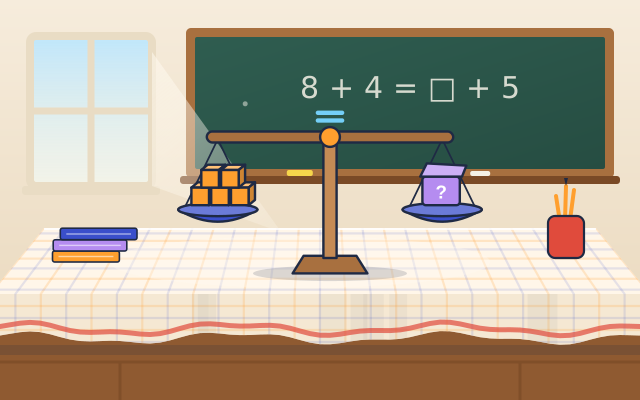
How many cubes are hiding in the box?

Put cubes in the mystery box and watch which way the balance tips. The equals sign says both sides match.

The big question

Does the equals sign mean “write the answer”, or “both sides are the same”?

≈ 15 min exploring40-min lessonTurkish · EnglishNo scores

Choose a grade and start

The lab opens in the version for the grade you choose; grade and language can also be changed inside the lab.

How many cubes are in the box? I'm not sure either. Let's try!

How it works

What children do

Here is how the eight steps of the explorer cycle unfold in this lab.

  1. 1

    Ready?

    Meets the empty balance and the drawer of cubes, and sees a pan go down when a cube goes in.

  2. 2

    What do I know?

    Shows with fingers what goes in the box in 8 + 4 = □ + 5; nobody is told right or wrong (grade 1: which is heavier, the foam cube or the iron cube?).

  3. 3

    In everyday life

    Thinks about two friends balancing on a seesaw and the scales at the greengrocer's.

  4. 4

    Predict

    Chooses how many cubes to put in the box: 12, 17 or 7? The prediction is locked in.

  5. 5

    Try and observe

    The cubes drop into the box; with 12, the box's pan sinks. Replays the moment.

  6. 6

    Why?

    Sees that the equals sign says both sides are the same; the balance line lights up as “=”.

  7. 7

    Try something new

    Predicts first, then tries new equations; in grade 4, levels an unbalanced scale by adding or taking away cubes.

  8. 8

    My explorer notebook

    Picks the balanced scale out of three pictures and sees the prediction next to the result.

Mathematics

Grades and learning outcomes

Codes and outcomes come from the Turkish national curriculum taught in 2026–27, word for word in Turkish; the English here is our translation of that text, not an official version. Grade 4 follows the 2018 curriculum; its Maarif Model equivalent is shown separately.

Grade 1

Start

Two scenes: “Which is heavier?” (estimating mass; no + or =) and “What does equals mean?” (adding and subtracting up to 20).

  • MAT.1.1.8Maarif Model 2026· translated from Turkish

    Estimating the results of measuring the length of objects and the mass to be weighed, using suitable non-standard measuring tools

    • a) Chooses a non-standard measuring tool suited to the length and mass to be measured.
    • b) Estimates the length to be measured and the mass to be weighed in the chosen non-standard unit.
    • c) Judges how accurate the estimate was.
  • MAT.1.2.3Maarif Model 2026· translated from Turkish

    Interpreting the meaning of the equals sign in the context of addition and subtraction

    • a) Examines how the equals sign is used in addition and subtraction.
    • b) Uses the meaning of the equals sign to transform an addition or a subtraction.
    • c) Describes the additions and subtractions they transformed in their own words.
Grade 2

Start

“What does equals mean?”: the different meanings of equality across the four operations; one mystery box per equation.

  • MAT.2.2.6Maarif Model 2026· translated from Turkish

    Interpreting the different meanings of equality in the context of the four operations

    • a) Examines equality in the four operations according to its different meanings.
    • b) Uses the meaning of equality to express situations that give the same result in the four operations with different numbers.
    • c) Expresses the meanings of equality in the context of the four operations.

Grade 3

Start

“What does equals mean?”: equations with multiplication and division, including ones with the result on the left (□ = 5 + 7).

  • MAT.3.2.8Maarif Model 2026· translated from Turkish

    Interpreting the different meanings of equality in the context of the four operations

    • a) Examines how equality is used in the four operations.
    • b) Uses the meaning of equality to express operations that give the same result with different numbers.
    • c) Expresses the meanings of equality in the context of the four operations.

Grade 4

Start

“What does equals mean?” and “Make it balance”: find the missing value; add or take away cubes to make two unequal expressions equal.

  • M.4.1.5.72018 curriculum· translated from Turkish

    Finds the missing value in one of two mathematical expressions that are equal, and explains why the equality holds.

    • For example 8 + … = 15 − 3; 12 : 4 = … + 1; 6 x … = 48 − 12
  • M.4.1.5.82018 curriculum· translated from Turkish

    Explains the operations needed to make two unequal mathematical expressions equal.

    • For example, for 8+5 ≠ 12-3 the class looks at the operations that could make the two sides equal.

Equivalent from 2027–28

  • MAT.4.2.9Maarif Model 2026· translated from Turkish

    Interpreting the different meanings of equality in the context of the four operations

    • a) Examines the concept of equality in the context of the four operations.
    • b) Turns everyday situations into the four operations.
    • c) Expresses an everyday situation involving the four operations in terms of equality.

Curriculum mapping

This lab is mapped to learning outcomes M.4.1.5.7 and M.4.1.5.8 of the Turkish Ministry of National Education's 2018 Mathematics curriculum. It has not been reviewed or approved by the Ministry of National Education (MEB) or its Board of Education (TTKB).

This lab is mapped to learning outcomes MAT.1.1.8, MAT.1.2.3, MAT.2.2.6 and MAT.3.2.8 of the Turkish Ministry of National Education's Türkiye Century Maarif Model Mathematics curriculum (2026 version). It has not been reviewed or approved by the Ministry of National Education (MEB) or its Board of Education (TTKB).

From the 2027–28 school year, the grade 4 equivalent in the Türkiye Century Maarif Model is MAT.4.2.9.

For teachers

Teacher notes

Open the teacher card

Goal

Children read the equals sign as “both sides are the same”, not “write the answer”, and find the number for the box by comparing both sides.

Getting ready

  • Open the lab on the board or a tablet and pick the grade.
  • For the screen-free activity: a clothes hanger, two paper cups, string and identical units (same-size paper clips, cubes or marbles).
  • In grade 1, don't use the + and = signs before the “What does equals mean?” scene (spring term).

Class prediction vote

8 + 4 = □ + 5. How many cubes go in the box?

  • 12
  • 17
  • 7

Children show their choice with their fingers and you count. Then you watch the result together.

Discussion questions

  1. Why 7? How do you know?
  2. What if we put 12 in the box? Which way would the scale tip?
  3. What is the equals sign telling us?

Avoid saying

“After the equals sign, we write the answer.”

Say instead

“The equals sign shows that both sides are the same.”

Off-screen activity for the teacher's desk: Hanger balance

Tie a paper cup to each end of a clothes hanger; one pupil holds the hanger up by a pencil. Put the same empty box in each cup and secretly hide some units in one. The class predicts first, then you open the box.

You need

  • A clothes hanger
  • Two paper cups and string
  • Identical units: paper clips, cubes or marbles
  • Two empty boxes of the same size

Misconceptions

What children may think“Equals means write the answer.” (12 or 17 for 8 + 4 = □ + 5)
What the lab showsWith 12 in the box, its pan sinks; with 7, the scale levels out.
What children may think“Bigger things are heavier.” (grade 1)
What the lab showsThe pan with the small iron cube goes down; the big foam cube stays up.

Scope

There is one mystery box per task. The rule “add or take away the same on both sides” (a grade 7 topic) is not taught; ≠ appears only in grade 4.

Preparing the experience…